Welcome to our classroom blog...

Welcome to the grade 12 precalculus math blog of St.James Collegiate....

Tuesday, March 22, 2011

March 22, 2011

I have attached today's first lesson on solving Trig Identities. 

Identities Lesson 1

Remember to always pick one side and "work it out" to look like the other side.  Many of these solutions come out quite easily if you express everything on the most complex side in terms of sine and cosine only.  There can be various ways to arrive at the same solution so don't despair if your neighbor has completed the solution in a different way.

Example 1: 

Prove that
sin y + sin y cot2 y = csc y :         SOLUTION BELOW
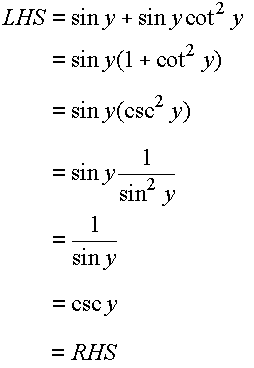

Example 2: 

Prove that
sin x cos x tan x = 1 − cos2 x:    SOLUTION BELOW

Example 3:

Prove that
Image     SOLUTION BELOW

The handout sheet of Identities is due to hand in on Friday March 25th, 2011.  Remember you only need to complete the ODD number questions.   Please hand in at the end of class.

Trigonometric Identities

Moving on to the third unit, we discussed a very challenging lesson on how to prove Trigonometric Identities.


First, we did a recap about the eight trigonometric identities (Pythagorean and Reciprocal)


Pythagorean/Main Identities:

☻cos2θ + sin2θ = 1 ---> dividing both sides by cos2θ and by sin2θ, you'll get:

☻1 + tan2θ = sec2θ and ☻1 + cot2θ = csc2θ respectively.


Reciprocal/Basic Identities:

☻sinθ = 1/cscθ ☻cscθ = 1/sinθ

☻cosθ = 1/secθ ☻secθ = 1/cosθ

☻tanθ = 1/cotθ ☻cotθ = 1/tanθ


Next, in order to prove equations using identities, you must:


  1. Use basic identity substitution.

  2. Change everything to sine or cosine

  3. Simplify all complex fractions into simple fraction.

  4. Use fraction rules for addition and subtraction.

  5. Factor if exponents are not the same on both sides.


Lastly, here are some important things to consider in this unit:

  1. Familiarize yourself with all the 8 trig. identities. The better you know them, the easier it will be to recognize what is going on in the problems.

  2. Work on the most complex side and simplify it so that it has the same form as the simplest side.

  3. Don't work on both sides of the equation and try to meet in the middle. Start on one side and make it look like the other side.

  4. In most examples where you see power 2 (that is, 2), it will involve using the Pythagorean identities or their derivatives.


Feel free to post a comment if there are points or clarifications you might want to add!

Carpe diem!

Model and Solve Problems using Trig Functions - March 21, 2011

We have finished up with Unit B on Transformations.  The last two lessons are attached in the links.  Enjoy!

Transformations Lesson 5

Transformations Lesson 6

Friday, March 18, 2011

March 17,2011

What's coming up???

A busy week just around the corner....
Week before spring break...Yahoooo!!!

On Monday we will finish up with our last lesson in the Transformations Unit.  Exercise 13 lesson looking at some real life context situations for using sinusoidal equations.


How in the world is this Ferris Wheel connected to sinusoidal equations???

Stay tuned...
Tuesday and Wednesday we will get into our next unit on Identities.  Look interesting?? 

Thursday and Friday will be working days on both Unit A and Unit B Review.  
Over spring break you will have two review booklets to complete in preparation for the unit assessments coming up. 
 
If you are having trouble with any of the review work, post a blog about the specific question.  One of your classmates may be able to help you out with the solution.  I will post the answers to the booklets on Sunday April 3rd so that you can check your work just in time for getting back on Monday.

Be sure to visit the blog!

We will continue on with Identities when we get  back on Monday April 4th.


Transformations Unit Assessment - Tuesday April 12th,2011.

Identities Unit Assessment - Thursday April 14th, 2011. 


Wednesday, March 16, 2011


Graphing Reciprocal Functions, Absolute Values and Trig Reciprocals Review
(March 16,2011)
Todays class was extremely productive. We covered almost three exercises in under two hours. (YAY!) In the morning, we finished off the notes from exercise 10(graphing reciprocal functions), and Graphing Absolute Values(exercise 11) and in the afternoon, got right into Graphing Trig Reciprocals. Summary of todays notes will be posted down below so keep reading. =)

Exercise 10: Graphing Reciprocal Functions
Steps in graphing a reciprocal function:
  • First of all, make sure you use the reciprocal of the function instead of the original one.
  • Next, you have to find the asymptote. To do this you have take the denominator (-x/2-2) and set y to 0:
  • ( 0=-x/2-2 and solve for "x")
  • Once you have "x" you can then draw in your asymptote with a dotted line (in this case x=-4, so our asymptote=-4
  • Then find the invariant points(turn points). ***Remember in reciprocal graphs, the invariant points are located at y=1 & y=-1 (Again take the denominator and set y to -1 and 1) 1=-x/2-2 and -1=-x/2-2 then solve for "x".
  • Next plot these points and graph the reciprocal function


Exercise 11: Graphing Absolute Values
The easiest way to graph absolute values is to make a table of values.
- But remember that the absolute value of a function is always positive or zero. So all the points that are below the x-axis(-ve points) get reflected to above the x-axis.
Your new table of values should look like
this:

- Next just plot the points in the graph and connect the dots.


NO NEGATIVE "Y" VALUES


Graphing Trig Reciprocals:
Example:Graph a Cosecant Graph (We all know from the previous unit that Cosecant is the reciprocal of sin. (Cosecant= 1/sinx)
-Start off by graphing your typical y=sinx graph
-Indentify your asymptotes (where y=0) and draw them on the graph with dotted lines
(Asymptotes for this graph would be: -2π,-π, 0, π and 2π)
- Find the Invariant points again (where sin=1 or sin=-1) in this case they are
-3π/2, -π/2,π/2,3π/2
-Lastly, determine whether sin is +ve or -ve in your invariant points.
If sin is -ve, graph will curve downwards, if it is +ve, graph will curve up
(Use the CAST rule is you have trouble remembering)
YOUR FINAL GRAPH SHOULD LOOK LIKE THIS!

That's it!.....hope these notes help.


oh and tomorrow's blogger will be NM
(cause he missed his turn)

More from today's lessons...March 16th, 2011

Transformations Lesson 4

Drawing Reciprocal Trigonometric Functions Lesson 4b

Secant Graph


Cosecant Graph

Useful Transformations Tutorials...

Secant Graphs Tutorial

Cosecant Graphs Tutorial